Manufacturing Website Design: How Industrial Websites Win Enquiries From Buyers
Manufacturing website design that brings enquiries: product structure, specifications, capability proof, RFQ forms, catalogues, SEO and export buyers.

Quick answer
A manufacturing website should help a buyer or engineer confirm, quickly, that you make what they need, to the standard they need, at the scale they need. Build a page for every product line with specifications and applications, show plant capability and certifications, add a short quote request form and downloadable catalogues, and structure pages around the product and application searches buyers actually make.
Industrial buyers do not browse websites for fun. A procurement manager, a design engineer or a project head lands on your site with a specific requirement and a shortlist to fill. Within a minute, they decide whether you belong on it. Good manufacturing website design makes that decision easy, by putting products, specifications, capability and proof exactly where buyers look.
Here is how to structure a manufacturing website that brings enquiries.
Who visits a manufacturing website?
| Visitor | What they look for |
|---|---|
| Procurement and purchase | Product range, capacity, certifications, lead times, how to request a quote |
| Engineers and designers | Specifications, materials, tolerances, drawings, standards |
| Project heads and owners | Experience in their industry, scale, past projects, reliability |
| Distributors and exporters | Range, packaging, export experience, documentation |
| Job seekers | What it is like to work there |
Each needs a clear path. The navigation should make it obvious where each type of visitor goes.
Structure the site around products and applications
Buyers search for products and for problems. Build both:
- Product category pages, each listing the products in that category
- Product pages for key products: description, specifications table, materials, sizes, finishes, applications, photos and downloads
- Application or industry pages: "signage for retail chains", "packaging for pharmaceuticals", "fabrication for food processing plants"
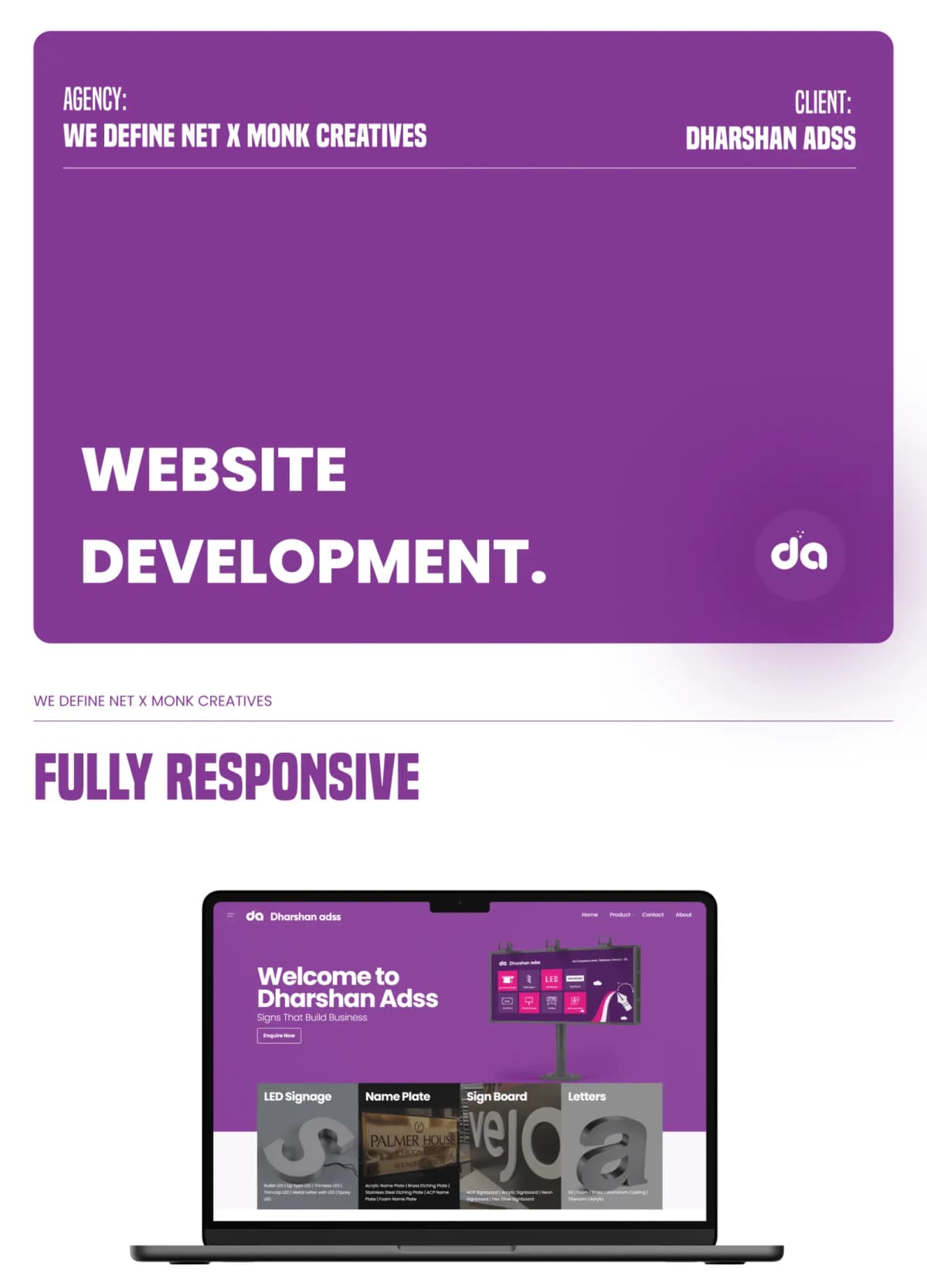
For Dharshan Adss, a signboard manufacturer, we built a structured, search-optimised site with a page for every product category and clear calls to action. The owner reported a 400% increase in profit within three months.
Specifications are content, not an afterthought
Engineers want data. Put it on the page, not only in a PDF:
- A specification table on every product page: dimensions, materials, tolerances, capacity, finishes, standards met
- Units clearly stated
- Downloadable datasheets and drawings, named clearly
- Notes on customisation: what can be changed and what cannot
Text on the page can be read by search engines and AI assistants; text locked in a scanned PDF cannot.
Show capability and quality
Buyers need confidence that you can deliver at their scale and standard:
- Plant and machinery: real photos and a list of key equipment with capacities
- Capacity: monthly output, shifts, maximum sizes or volumes
- Quality: ISO and other certifications, testing processes, quality control steps
- Experience: years in business, industries served, notable projects (with permission)
- Team: key people, especially for engineering-led businesses
Avoid generic stock images of factories and handshakes. Real photos of your floor, products and team are far more convincing.
Make the quote request effortless
The request for quote (RFQ) form is your most important conversion point.
- Keep it short: name, company, phone, email, product, quantity, and a field for requirements
- Allow file uploads for drawings and specifications
- Say what happens next and how quickly you respond
- Place a "Request a quote" button on every product page and in the header
- Offer phone and WhatsApp alongside the form
Route enquiries to the right person immediately, and respond within hours. B2B buyers usually contact several suppliers at once.
Downloads and catalogues
Offer downloadable catalogues, brochures and certificates, but do not hide all your content in PDFs. A good pattern is a short, clear web page per product with the PDF as an extra. Consider asking for an email only for detailed catalogues, not basic product information.
SEO for manufacturers
Industrial searches are specific and often low in volume, but high in value. One enquiry can be worth a large order.
- Research the exact terms buyers use, including product names, materials and applications. Our keyword research guide explains how.
- Give each product and application its own page with a descriptive title.
- Add Product and Organization structured data; see our schema markup guide.
- Publish technical answers engineers search for: material comparisons, standards explained, how to specify a product.
- Keep your Google Business Profile and B2B listings complete; see business listing sites in India.
Our B2B SEO strategy goes deeper.
Export buyers
If you sell abroad:
- Write in clear international English, with units in both metric and imperial where relevant
- Show export experience: countries served, documentation, packaging, Incoterms you work with
- Make time zones and contact options clear
- Consider additional languages for key markets; see our multilingual website guide
- Make sure the site loads quickly from abroad
Speed and mobile still matter
Buyers increasingly research on phones, even for industrial products. Keep pages fast, images optimised and the quote button reachable on mobile.
Mistakes industrial websites make
- "Products" is one page with a grid of photos and no detail, so nothing can rank and engineers leave.
- Everything is in a single PDF catalogue, which search engines and AI assistants cannot read properly.
- The homepage talks about vision and mission instead of what you make and for whom.
- Factory photos are stock images that buyers recognise from other websites.
- No file upload on the enquiry form, so buyers cannot send drawings.
- Contact details are only on the contact page, not in the header and on every product page.
- The site was built once and never updated, so new product lines, certifications and machinery are missing.
- Enquiries go to a general inbox that nobody checks daily.
Fixing the first two alone often changes how many search enquiries a manufacturer gets, because each product suddenly has a page that can be found.
A manufacturing website checklist
- Clear statement of what you make and for which industries on the homepage
- Product category and product pages with specifications on the page
- Application or industry pages
- Plant, capacity and quality proof with real photos
- Certifications and client proof
- Short RFQ form with file upload on every product page
- Downloadable datasheets and catalogues
- SEO structure around product and application searches
- Export information if relevant
- Fast, mobile-friendly pages
For the wider set of channels that bring industrial buyers, read our guide to B2B lead generation in India and B2B website design best practices. If you would like a manufacturing website built to win enquiries, our B2B website development team has built industrial sites for manufacturers, contractors and exporters.
Work with us
B2B Website Development from The Coral Flow
Get a free B2B website review. Send your website. We review it the way your buyers do, and show you where leads are slipping away.
Frequently asked questions
What should a manufacturer's website include?
A page for each product category and key product, specifications and applications, plant and machinery capability, quality certifications, industries served, client logos or case studies, downloadable catalogues and a request for quote form.
Should manufacturers show prices online?
Most custom and B2B manufacturers do not, because pricing depends on specifications and volume. Instead, make the quote request fast and explain what information you need to quote accurately.
How do manufacturers get leads from a website?
By ranking for the specific product and application searches buyers make, making it easy to send a requirement, and responding quickly. Listings on B2B marketplaces and LinkedIn activity bring additional buyers to the site.
Do manufacturing websites need a blog?
A blog or resource section helps when it answers technical questions buyers and engineers search for, such as material comparisons, tolerances or standards. It builds authority and brings early-stage research traffic.
Written by
Parves, Founder and Creative Director
Leads strategy and creative direction at The Coral Flow in Chennai, across web, search and content for brands in India and abroad.